# VideoCLIP and VLM
You just find this toolkit for multimodal video understanding! It contains implementation of two recent multi-modal video understanding papers [VideoCLIP](https://arxiv.org/pdf/2109.14084.pdf) (EMNLP, 2021) and [VLM](https://aclanthology.org/2021.findings-acl.370.pdf) (ACL Findings, 2021), along with high-performance toolkits that are typically lacking in existing codebase. The toolkit is desigend to contain generic performance-tuned components that can be potentially adapted to other frameworks (we initially use fairseq).
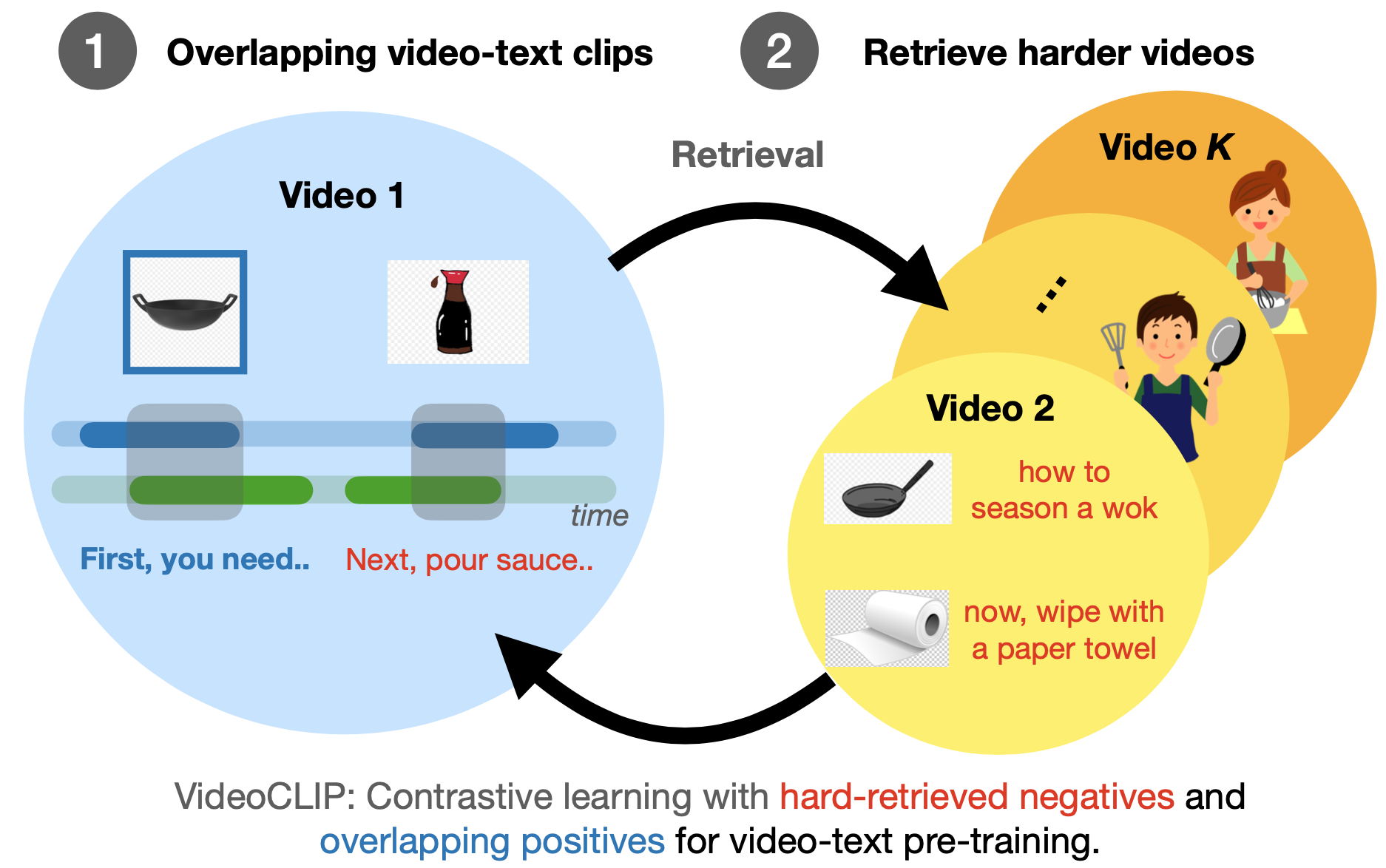
VideoCLIP is a contrastive learning model for zero-shot transfer to retrieval/classification/sequence labeling style tasks.
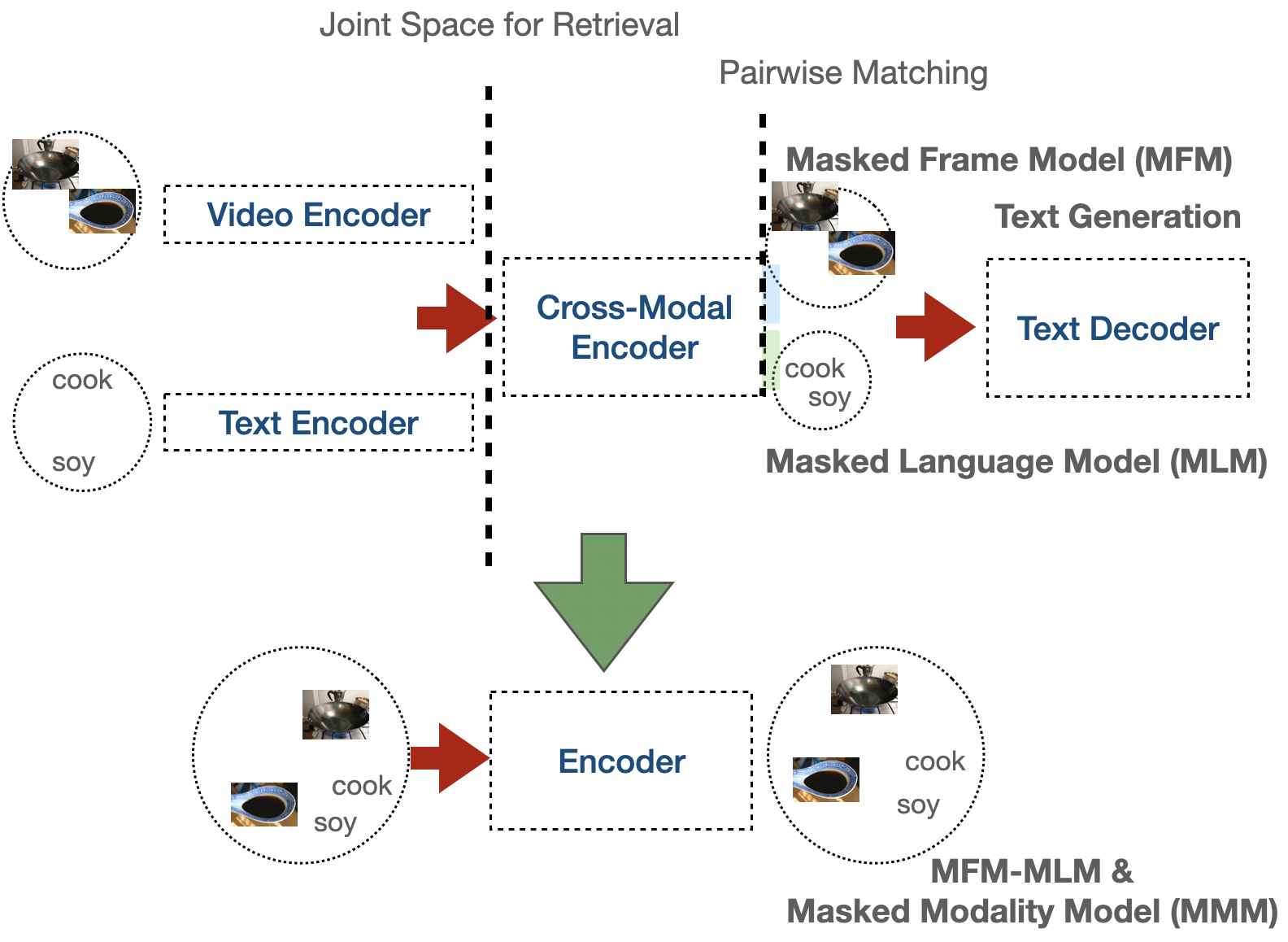
 VLM is a masked language model style pre-training using only one encoder with masked modality model (MMM) for retrieval/generation/sequence labeling style tasks.
 ### News
[Oct. 2021] Initial release of implementation for the following papers:
[VideoCLIP: Contrastive Pre-training for Zero-shot Video-Text Understanding](https://arxiv.org/pdf/2109.14084.pdf) (Xu et. al., EMNLP 2021)
[VLM: Task-agnostic Video-Language Model Pre-training for Video Understanding](https://aclanthology.org/2021.findings-acl.370.pdf) (Xu et. al., ACL Findings 2021)
### Installation
We aim to minimize the dependency of this repo on other packages.
We use fairseq as the main trainer (no models/datasets dependency on fairseq. We will support other trainer in future):
```
git clone https://github.com/pytorch/fairseq
cd fairseq
pip install -e . # also optionally follow fairseq README for apex installation for fp16 training.
export MKL_THREADING_LAYER=GNU # fairseq may need this for numpy.
```
Then install this toolkit:
```
cd examples/MMPT # MMPT can be in any folder, not necessarily under fairseq/examples.
pip install -e .
```
The code is developed under Python=3.8.8, Pytorch=1.8, cuda=11.0 with fairseq=1.0.0a0+af0389f and tested under Python=3.8.8 pytorch=1.9 cuda=11.0 fairseq=1.0.0a0+8e7bc73 during code release.
Most models require `transformers==3.4` for API compatibility `pip install transformers==3.4`.
In addition, some downstream tasks may need `conda install pandas`.
### Usage
#### Download Checkpoints
We use pre-trained [S3D](https://github.com/antoine77340/S3D_HowTo100M) for video feature extraction. Please place the models as `pretrained_models/s3d_dict.npy` and `pretrained_models/s3d_howto100m.pth`.
Download VideoCLIP checkpoint `https://dl.fbaipublicfiles.com/MMPT/retri/videoclip/checkpoint_best.pt` to `runs/retri/videoclip` or VLM checkpoint `https://dl.fbaipublicfiles.com/MMPT/mtm/vlm/checkpoint_best.pt` to `runs/mtm/vlm`.
#### Demo of Inference
run `python locallaunch.py projects/retri/videoclip.yaml --dryrun` to get all `.yaml`s for VideoCLIP.
```python
import torch
from mmpt.models import MMPTModel
model, tokenizer, aligner = MMPTModel.from_pretrained(
"projects/retri/videoclip/how2.yaml")
model.eval()
# B, T, FPS, H, W, C (VideoCLIP is trained on 30 fps of s3d)
video_frames = torch.randn(1, 2, 30, 224, 224, 3)
caps, cmasks = aligner._build_text_seq(
tokenizer("some text", add_special_tokens=False)["input_ids"]
)
caps, cmasks = caps[None, :], cmasks[None, :] # bsz=1
with torch.no_grad():
output = model(video_frames, caps, cmasks, return_score=True)
print(output["score"]) # dot-product
```
#### Data Preparation
See [dataset](DATASET.md) for each dataset.
#### Global Config for Training Pipeline
We organize a global config file for a training/testing pipeline under projects (see a detailed [explanation](CONFIG.md)). For example, VideoCLIP in `projects/retri/videoclip.yaml` and VLM is in `projects/mtm/vlm.yaml`.
We wrap all cmds into `locallaunch.py` and `mmpt_cli/localjob.py`. You can check concrete cmds by `--dryrun` and then drop it for actual run.
First, run `python locallaunch.py projects/retri/videoclip.yaml --dryrun` will generate configs for all configs of pre-training, zero-shot evaluation, fine-tuning and testing, for VideoCLIP under `projects/retri/videoclip`.
Then each (either training or evaluation) process will be configed by a concrete config file (we save all complex arguments into the concrete config file for reproducibility, including fairseq args). For example, run zero-shot evaluation on youcook,
```
python locallaunch.py projects/retri/videoclip/test_youcook_zs.yaml --jobtype local_predict # zero-shot evaluation.
python locallaunch.py projects/retri/videoclip/youcook_videoclip.yaml --jobtype local_single --dryrun # fine-tuning: use --dryrun to check cmds and drop it to make an actual run; local_small will run on two gpus (as in paper).
python locallaunch.py projects/retri/videoclip/test_youcook_videoclip.yaml --jobtype local_predict # testing on fine-tuned model.
```
Pretraining can be run as:
```
python locallaunch.py projects/retri/videoclip/how2.yaml --jobtype local_single --dryrun # check then drop dryrun; paper is ran on local_big as 8 gpus.
```
You may need to change `--jobtype`, check/extend `LocalJob` in `mmpt_cli/localjob.py` for multi-gpu/multi-node pre-training.
The detailed instructions of pretraining and fine-tuning can be found at [pretraining instruction](pretraining.md) and [finetuning instruction](endtask.md).
### Development
Several components of this toolkit can be re-used for future research (and also our ongoing research).
#### Framework Wrapper
We currently only support fairseq, but most components can be easily fit into other frameworks like huggingface. This repo is a `--user-dir` of fairseq with fairseq wrapper. For example, `mmpt/tasks` includes a `FairseqMMTTask`, which manages `mmpt/datasets` with `FairseqDataset`, `mmpt/models` with `FairseqModel`, `mmpt/losses` with `FairseqCriterion`.
#### Processors
**Multi**modal research introduces the complexity on modality alignment from different input sources to losses. Inspired by [MMF](https://github.com/facebookresearch/mmf), this toolkit leverages `mmpt/processors` to handle various needs of data preprocessing and loading, **alleviating** the needs of multiple `torch.data.utils.Dataset` (that can be tricky for ablation study).
Processors can also be decoupled from `torch.data.utils.Dataset` for offline preprocessing instead of on-the-fly data preprocessing.
We decouple a `mmpt.MMDataset` as 3 types of processors: `MetaProcessor`, `VideoProcessor`, `TextProcessor` and `Aligner`. They can be configed in `dataset` field of a config file (e.g., see `projects/task/how2.yaml`).
`MetaProcessor` is used to load the meta data about a dataset, aka, all video_ids of how2 dataset.
`VideoProcessor` is used to load the video features about a dataset. For example, S3D features for each second of a video.
`TextProcessor` is used to load the text (feature). For example, BERT pre-tokenized text clips for how2 dataset (with `start`s, `end`s of timestamps and `cap` for `token_ids`).
`Aligner` is the core class for different baselines that prepares the training data. For example, sampling a clip, masking tokens for MLM, etc.
#### Performance-tuned Components
To speed up pre-training, this toolkit uses sharded features stored in mmaped numpy, backed by `ShardedTensor` in `mmpt/utils/shardedtensor.py` (adopted from MARGE paper). This reduces the loads of IO for multi-GPU training without loading all features for a video into the memory each time and `ShardedTensor` ensure features are stored in continuous disk space for near random access. This is used for both How2 video features and texts in `mmpt/processors/how2processor.py`.
### Citation
If this codebase is useful for your work, please cite the following papers:
```BibTeX
@inproceedings{xu-etal-2021-videoclip,
title = "{VideoCLIP}: Contrastive Pre-training for\\Zero-shot Video-Text Understanding",
author = "Xu, Hu and
Ghosh, Gargi and
Huang, Po-Yao and
Okhonko, Dmytro and
Aghajanyan, Armen and
Metze, Florian and
Zettlemoyer, Luke and
Feichtenhofer, Christoph",
booktitle = "Proceedings of the 2021 Conference on Empirical Methods in Natural Language Processing (EMNLP)",
month = nov,
year = "2021",
address = "Online",
publisher = "Association for Computational Linguistics",
}
@inproceedings{xu-etal-2021-vlm,
title = "{VLM}: Task-agnostic Video-Language Model Pre-training for Video Understanding",
author = "Xu, Hu and
Ghosh, Gargi and
Huang, Po-Yao and
Arora, Prahal and
Aminzadeh, Masoumeh and
Feichtenhofer, Christoph and
Metze, Florian and
Zettlemoyer, Luke",
booktitle = "Findings of the Association for Computational Linguistics: ACL-IJCNLP 2021",
month = aug,
year = "2021",
address = "Online",
publisher = "Association for Computational Linguistics",
url = "https://aclanthology.org/2021.findings-acl.370",
doi = "10.18653/v1/2021.findings-acl.370",
pages = "4227--4239",
}
```
### Bug Reports
This repo is in its initial stage, welcome bug reports to huxu@fb.com
### Copyright
The majority of Multimodal Pre-training (MMPT) is licensed under CC-BY-NC, however portions of the project are available under separate license terms: Evaluation Codes/Models: Howto100M and HuggingFace Transformers are licensed under the Apache2.0 license; COIN and NLG-eval are licensed under the MIT license; CrossTask is licensed under the BSD-3; DiDeMo is licensed under the BSD-2 license.
### News
[Oct. 2021] Initial release of implementation for the following papers:
[VideoCLIP: Contrastive Pre-training for Zero-shot Video-Text Understanding](https://arxiv.org/pdf/2109.14084.pdf) (Xu et. al., EMNLP 2021)
[VLM: Task-agnostic Video-Language Model Pre-training for Video Understanding](https://aclanthology.org/2021.findings-acl.370.pdf) (Xu et. al., ACL Findings 2021)
### Installation
We aim to minimize the dependency of this repo on other packages.
We use fairseq as the main trainer (no models/datasets dependency on fairseq. We will support other trainer in future):
```
git clone https://github.com/pytorch/fairseq
cd fairseq
pip install -e . # also optionally follow fairseq README for apex installation for fp16 training.
export MKL_THREADING_LAYER=GNU # fairseq may need this for numpy.
```
Then install this toolkit:
```
cd examples/MMPT # MMPT can be in any folder, not necessarily under fairseq/examples.
pip install -e .
```
The code is developed under Python=3.8.8, Pytorch=1.8, cuda=11.0 with fairseq=1.0.0a0+af0389f and tested under Python=3.8.8 pytorch=1.9 cuda=11.0 fairseq=1.0.0a0+8e7bc73 during code release.
Most models require `transformers==3.4` for API compatibility `pip install transformers==3.4`.
In addition, some downstream tasks may need `conda install pandas`.
### Usage
#### Download Checkpoints
We use pre-trained [S3D](https://github.com/antoine77340/S3D_HowTo100M) for video feature extraction. Please place the models as `pretrained_models/s3d_dict.npy` and `pretrained_models/s3d_howto100m.pth`.
Download VideoCLIP checkpoint `https://dl.fbaipublicfiles.com/MMPT/retri/videoclip/checkpoint_best.pt` to `runs/retri/videoclip` or VLM checkpoint `https://dl.fbaipublicfiles.com/MMPT/mtm/vlm/checkpoint_best.pt` to `runs/mtm/vlm`.
#### Demo of Inference
run `python locallaunch.py projects/retri/videoclip.yaml --dryrun` to get all `.yaml`s for VideoCLIP.
```python
import torch
from mmpt.models import MMPTModel
model, tokenizer, aligner = MMPTModel.from_pretrained(
"projects/retri/videoclip/how2.yaml")
model.eval()
# B, T, FPS, H, W, C (VideoCLIP is trained on 30 fps of s3d)
video_frames = torch.randn(1, 2, 30, 224, 224, 3)
caps, cmasks = aligner._build_text_seq(
tokenizer("some text", add_special_tokens=False)["input_ids"]
)
caps, cmasks = caps[None, :], cmasks[None, :] # bsz=1
with torch.no_grad():
output = model(video_frames, caps, cmasks, return_score=True)
print(output["score"]) # dot-product
```
#### Data Preparation
See [dataset](DATASET.md) for each dataset.
#### Global Config for Training Pipeline
We organize a global config file for a training/testing pipeline under projects (see a detailed [explanation](CONFIG.md)). For example, VideoCLIP in `projects/retri/videoclip.yaml` and VLM is in `projects/mtm/vlm.yaml`.
We wrap all cmds into `locallaunch.py` and `mmpt_cli/localjob.py`. You can check concrete cmds by `--dryrun` and then drop it for actual run.
First, run `python locallaunch.py projects/retri/videoclip.yaml --dryrun` will generate configs for all configs of pre-training, zero-shot evaluation, fine-tuning and testing, for VideoCLIP under `projects/retri/videoclip`.
Then each (either training or evaluation) process will be configed by a concrete config file (we save all complex arguments into the concrete config file for reproducibility, including fairseq args). For example, run zero-shot evaluation on youcook,
```
python locallaunch.py projects/retri/videoclip/test_youcook_zs.yaml --jobtype local_predict # zero-shot evaluation.
python locallaunch.py projects/retri/videoclip/youcook_videoclip.yaml --jobtype local_single --dryrun # fine-tuning: use --dryrun to check cmds and drop it to make an actual run; local_small will run on two gpus (as in paper).
python locallaunch.py projects/retri/videoclip/test_youcook_videoclip.yaml --jobtype local_predict # testing on fine-tuned model.
```
Pretraining can be run as:
```
python locallaunch.py projects/retri/videoclip/how2.yaml --jobtype local_single --dryrun # check then drop dryrun; paper is ran on local_big as 8 gpus.
```
You may need to change `--jobtype`, check/extend `LocalJob` in `mmpt_cli/localjob.py` for multi-gpu/multi-node pre-training.
The detailed instructions of pretraining and fine-tuning can be found at [pretraining instruction](pretraining.md) and [finetuning instruction](endtask.md).
### Development
Several components of this toolkit can be re-used for future research (and also our ongoing research).
#### Framework Wrapper
We currently only support fairseq, but most components can be easily fit into other frameworks like huggingface. This repo is a `--user-dir` of fairseq with fairseq wrapper. For example, `mmpt/tasks` includes a `FairseqMMTTask`, which manages `mmpt/datasets` with `FairseqDataset`, `mmpt/models` with `FairseqModel`, `mmpt/losses` with `FairseqCriterion`.
#### Processors
**Multi**modal research introduces the complexity on modality alignment from different input sources to losses. Inspired by [MMF](https://github.com/facebookresearch/mmf), this toolkit leverages `mmpt/processors` to handle various needs of data preprocessing and loading, **alleviating** the needs of multiple `torch.data.utils.Dataset` (that can be tricky for ablation study).
Processors can also be decoupled from `torch.data.utils.Dataset` for offline preprocessing instead of on-the-fly data preprocessing.
We decouple a `mmpt.MMDataset` as 3 types of processors: `MetaProcessor`, `VideoProcessor`, `TextProcessor` and `Aligner`. They can be configed in `dataset` field of a config file (e.g., see `projects/task/how2.yaml`).
`MetaProcessor` is used to load the meta data about a dataset, aka, all video_ids of how2 dataset.
`VideoProcessor` is used to load the video features about a dataset. For example, S3D features for each second of a video.
`TextProcessor` is used to load the text (feature). For example, BERT pre-tokenized text clips for how2 dataset (with `start`s, `end`s of timestamps and `cap` for `token_ids`).
`Aligner` is the core class for different baselines that prepares the training data. For example, sampling a clip, masking tokens for MLM, etc.
#### Performance-tuned Components
To speed up pre-training, this toolkit uses sharded features stored in mmaped numpy, backed by `ShardedTensor` in `mmpt/utils/shardedtensor.py` (adopted from MARGE paper). This reduces the loads of IO for multi-GPU training without loading all features for a video into the memory each time and `ShardedTensor` ensure features are stored in continuous disk space for near random access. This is used for both How2 video features and texts in `mmpt/processors/how2processor.py`.
### Citation
If this codebase is useful for your work, please cite the following papers:
```BibTeX
@inproceedings{xu-etal-2021-videoclip,
title = "{VideoCLIP}: Contrastive Pre-training for\\Zero-shot Video-Text Understanding",
author = "Xu, Hu and
Ghosh, Gargi and
Huang, Po-Yao and
Okhonko, Dmytro and
Aghajanyan, Armen and
Metze, Florian and
Zettlemoyer, Luke and
Feichtenhofer, Christoph",
booktitle = "Proceedings of the 2021 Conference on Empirical Methods in Natural Language Processing (EMNLP)",
month = nov,
year = "2021",
address = "Online",
publisher = "Association for Computational Linguistics",
}
@inproceedings{xu-etal-2021-vlm,
title = "{VLM}: Task-agnostic Video-Language Model Pre-training for Video Understanding",
author = "Xu, Hu and
Ghosh, Gargi and
Huang, Po-Yao and
Arora, Prahal and
Aminzadeh, Masoumeh and
Feichtenhofer, Christoph and
Metze, Florian and
Zettlemoyer, Luke",
booktitle = "Findings of the Association for Computational Linguistics: ACL-IJCNLP 2021",
month = aug,
year = "2021",
address = "Online",
publisher = "Association for Computational Linguistics",
url = "https://aclanthology.org/2021.findings-acl.370",
doi = "10.18653/v1/2021.findings-acl.370",
pages = "4227--4239",
}
```
### Bug Reports
This repo is in its initial stage, welcome bug reports to huxu@fb.com
### Copyright
The majority of Multimodal Pre-training (MMPT) is licensed under CC-BY-NC, however portions of the project are available under separate license terms: Evaluation Codes/Models: Howto100M and HuggingFace Transformers are licensed under the Apache2.0 license; COIN and NLG-eval are licensed under the MIT license; CrossTask is licensed under the BSD-3; DiDeMo is licensed under the BSD-2 license.